

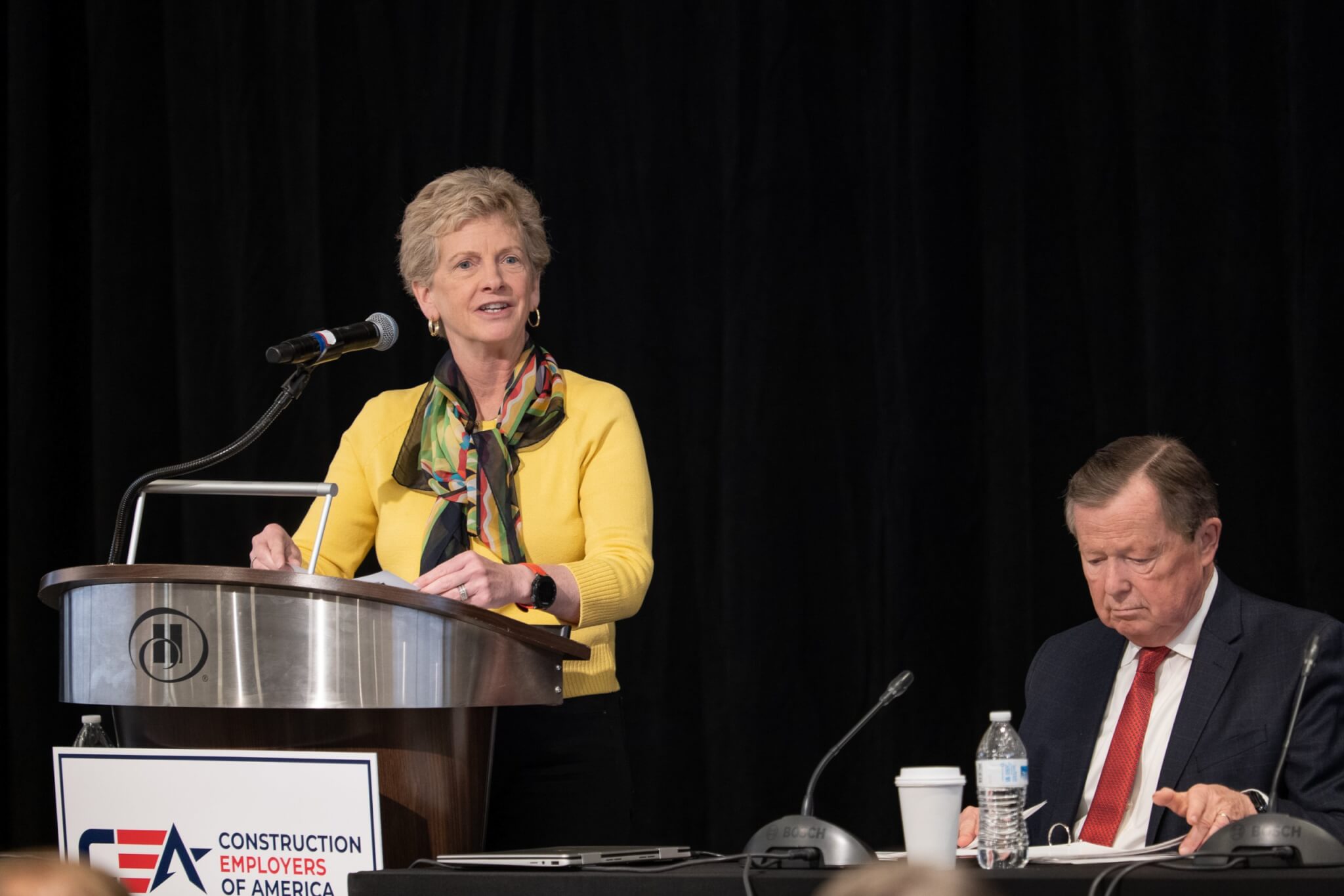
MCAA Government Affairs Committee Meeting
MCAA Government Affairs Committee and Construction Employers of America National Issues Conference held a strongly resurgent Washington, D.C. meeting and presence last week on Capitol Hill after a 3-year COVID hiatus.
Chairman Jim Gaffney convened MCAA Government Affairs Committee (GAC) Tuesday, May 2, at the law and lobbying offices of Alston & Bird in Washington, D.C., the first of two meetings this year. MCAA’s government affairs consultant and former 10-term Congressman Earl Pomeroy hosted the meeting. Pomeroy is now a member of the Alston & Bird lobbying practice.
This year, Gaffney invited members of the Mechanical Services Contractors Association (MSCA), MCAA’s Manufacturer/Supplier Council (M/SC) and included MSCA and M/SC issues on the meeting agenda and MCAA’s ongoing legislative and regulatory affairs agenda as well.
EPA Refrigerant Transition Process
The meeting kicked off with an hour-long presentation, Refrigerants – Change is Coming, from Thomas E. Watson, P.E., ASHRAE Fellow and former ASHRAE President, detailing the pending Environmental Protection Agency’s (EPA) regulatory program transitioning to HFC refrigerant phase-down under the Kigali Amendments to the Montreal Protocols environmental remediation international agreements. Watson, an Engineering Consultant for Daikin Applied Americas, and former chief engineer for Daiken North America, also detailed the trends in various states with more restrictive HFC refrigerant transition rules. Gaffney pledged the MCAA GAC to work in concert with MSCA and Watson’s efforts assessing the refrigerant transition and its impact on the service industry operations nationwide.
Decarbonization Trends Across the Country
Next up, Eric Truskowski from LAARS, a Bradford White Company in Ambler, Pennsylvania, detailed the various decarbonization rules and restrictions trending across the country among state and local regulatory authorities and the various ongoing legal challenges they face. Truskowski leads a program that monitors these ongoing developments and Gaffney dedicated the MCAA GAC efforts to work in coalition with tracking the decarbonization issues.
Ongoing Multiemployer Pension Reform Effort
Despite the $87 billion bailout of the multiemployer defined benefit pension system through the Pension Benefit Guaranty Corp’s Special Financial Assistance program under the Butch Lewis Act in the American Rescue Plan legislation last year, Gaffney noted that further simple and beneficial withdrawal liability allocation options could present the possibility for even more pension reform and long-term stability for multiemployer plans. According to Gaffney, if Congress were to allow plan trustees to adopt the simple two-pool withdrawal liability allocation method that’s denied only to construction plans, plan trustees could then adopt that method. Perhaps even in connection with an existing variable benefit plan design, that would allow those trustees to recoup even greater hours and participation from new employers taking advantage of the greater tax incentives for energy projects with employers performing the 10-year energy savings projects under the Biden administration’s Inflation Reductions Act.
Gaffney explained that new employers seeking CBA participation for the enhanced tax credits (paying prevailing wages and using set percentages of apprentice hours) for their owners and projects could sign into a two-pool plan without the fear of or burden of past legacy plan underfunding and potential withdrawal liability, which Gaffney characterized as a win-win-win proposition for plans and plan participants, union-signatory employers and project owners, given the proven productivity advantages on union-only projects set out in the UA/MCAA report with Independent Project Analysis (IPA), Quantifying the Value of Union Labor in Construction Projects (IPA Union Productivity Report).
Pennsylvania Congressman Brendan Boyle’s (D-PA) Chief of Staff, Tim Barnes, discussed these pension issues with the GAC members and noted that Rep. Boyle maintained his status on the Ways and Means Committee (with pension issue jurisdiction) while taking the job of also being ranking member on the powerful House Budget Committee.
Barnes also gave a comprehensive update on the ongoing deliberations on the government debt ceiling debate on Capitol Hill, providing an in-depth discussion of strategies to promote timely Congressional action to raise the debt ceiling before a debt default occurs in early June.
Review of MCAA GAC regulatory comments and activities – Chairman Gaffney concluded the Government Affairs Committee meeting with a review of recent MCAA GAC regulatory comments of significance to the industry:
- Recent MCAA comments to the Federal Trade Commission on its proposal to ban all employer/employee non-compete agreements nationwide as an unfair trade practice with detrimental market impacts. MCAA’s comments proposed a substantial revision to the proposal, allowing a high-level non-compete clause in the mechanical construction industry as a vital option to continue building on productivity advances in the industry. (This regulatory process is in the early stages.)
- Labor Department Wage and Hour Division proposed revisions to the Davis Bacon Act regulatory processes, rolling back regressive regulations pursued under the Regan Administration and maintained up until the Biden Administration review last year. MCAA supported returning to a fairer definition of the threshold for prevailing wages, several measures to provide more current and accurate wage determinations and the elements of the proposal that would allow DoL to adopt state prevailing wage processes that meet the federal standards. (Final regulations in later stages of development – legal challenge likely upon publication.)
- The Biden administration’s proposed consideration and use of Project Labor Agreements for major projects of $35 million and more– MCAA’s comments support the Biden administration’s PLA executive order and proposed regulations. The comments included an analysis of the IPA Union Productivity Report, validating the administration’s premise for the PLA rule that union projects are demonstrably more beneficial for the owner than all non-union projects or even mixed union/non-union projects. (Final regulations under development – legal challenges are likely upon publication of final regulations.)
- Proposed direct federal construction project procurement reforms– The committee reviewed proposed General Services Administration regulations for reverse auctions in direct federal construction project contractor selection procedures. MCAA’s comment also called for the establishment of a Federal Acquisition Regulation Case in that rule making, addressing the Regan Administration’s rollback of major first-tier subcontractor bid listing on federal projects that GSA implemented for some 20 years before the Reagan rollback in 1983. (Final regulations pending.)
- Review of the UA/MCAA Mechanical Industry Advancement Fund (MIAF) IPA Union Sector Productivity Advantage Report– The Committee reviewed the IPA report and the ways that analysis can be helpful, in government policy discussions into the future on Davis Bacon, PLA and other policy discussions. (Public forums on the IPA report planned for June and future dates.)
Expanded Scope of Activity and Participation for the GAC in 2023 and Beyond
Gaffney slated the course for expanded committee activity and scope of work in 2023 and beyond. The GAC will work with the MSCA Board of Governors for the fly-in to DC on May 22, for another meeting hosted at Alston & Bird, with a representative from the Federal Trade Commission addressing their initiative to address right-to-repair issues under the Biden Administration’s Economic Competitiveness Executive Order. That meeting will address the Environmental Protection Agency refrigerant regulatory developments with a reprise from Tom Watson of his program described above. MCAA’s government affairs consultant Earl Pomeroy also will be guiding the MSCA Board of Governors on a tour of the Capitol from a members-only perspective.
In addition, Gaffney announced plans to hold another MCAA, MSCA and M/SC meeting in Washington, D.C. in September (exact date TBD) at Alston & Bird to pursue the tripartite mechanical construction industry regulatory and legislative agenda that the groups will pursue together in the future.
Construction Employers of America (CEA) National Issues Conference
Construction Employers of America (CEA) National Issues Conference came back strongly resurgent in-person, after a three-year COVID hiatus with virtual meetings standing in – Fully 113 union-signatory construction employer members of MCAA, The Association of Union Constructors (TAUC), and the Sheet Metal and Air Conditioning Contractors’ National Association (SMACNA) convened at the Washington Hilton National Mall/DC Wharf on May 3rd and 4th under the CEA banner with a full and active program from key Administration regulators and Hill lawmakers addressing our most important legislative and regulatory issues.
Over the course of the two days, CEA employers participated in 75 meetings with Representatives and Senators and the top staff, covering 47 Congressional districts and 28 Senate offices. With those ongoing contacts, despite the relatively light legislative agenda so far in the 118th Congress, CEA member contacts are essential to continue to build the CEA profile on Capitol Hill year after year to help defend the heavy presence and over-representation of the open shop in construction industry policy forums.
The two-day program again was moderated by former congressman Earl Pomeroy, whose in-depth background from a long-tenured distinguished service in Congress lends the conference an unrivaled expertise unique among industry legislative events.
The following is a capsule summary of the conference presentations, which concentrated on regulatory affairs, as the legislative issues so far aren’t well developed in the First Session of the 118th Congress.
Davis Bacon Regulatory Developments
U.S. Department of Labor Principal Deputy Administrator of the Wage and Hour Division Jessica Looman lead off the program with a description of the Administration’s rollback of the accretion of regressive Davis Bacon program regulations that started with the Reagan Administration. Looman also detailed the DoL initiative to staunch the scourge of child labor violations across all industries. Looman went on to discuss the apprentice hour utilization requirements under the Administration Inflation Reduction Act energy project enhanced tax credits for projects paying prevailing wage standards and meeting set apprentice hour utilization rates. In response to audience questions, Looman assured conference participants that DoL was working with the treasury to make sure the prevailing wage and apprentice utilization requirements are fairly met with proper compliance oversight.
Project Labor Agreement Regulatory Status
DoL Solicitor of Labor Senior Counsel Lafe Solomon referred generally to the status of the administration’s ongoing responsibility to implement project labor agreement requirements for direct federal projects of $35 million or more. Solomon took into consideration audience questions seeking union-signatory employer input and participation in any sub-regulatory guidance effort that DoL, GSA or OMB might deliver after the final PLA regulations are issued. Solomon was apprised of the status of the IPA Union Sector Productivity Report as potential strong support for the factual predicate underlying the PLA executive order and regulations.
Infrastructure Spending and Energy Project Tax Incentives
The Biden administration’s infrastructure and computer chip manufacturing programs and the IRA energy efficiency project enhanced tax credits were addressed by Laura O’Neill of the Commerce Department, and those same issues from the private perspective were addressed by Jessie Stolarik, Executive Director of the Carbon Capture Coalition.
GSA’s Public Building Program and Regulatory Initiatives
Robin Carnahan, Administrator of the U.S General Services Administration led the GSA discussion with a top-level overview of the agency’s support of the Administration’s public building market and environmental initiatives. Following that, GSA’s William Clark, Director of the Office of Government-wide Acquisition Policy and chair of the Civilian Agency Acquisition Council, along with GSA’s Tracy Marcinowski, Assistant Commissioner for Acquisitions at the Public Building Service both gave a broad overview of GSA’s spending and regulatory agenda. Meeting participants were able to pose questions about the underlying premise of the Obama administration’s paid sick leave requirements on direct federal contracts and request FAR consideration of union-signatory employer input on PLA implementation and other bidding and sub-bid listing policy considerations under the administration’s initiative to promote regulatory policies that support the national policy supporting collective bargaining.
Rep. Connolly (D-VA) Deficit Spending Policy and Federal Infrastructure Investment
Rep. Gerry Connolly (D-VA)addressed the conference concluding the morning agenda in advance of afternoon meetings on Capitol Hill. Congressman Connolly gave an impassioned speech detailing U.S policy relative to deficit spending and debt ceiling limits, and the overarching need for federal infrastructure investment through all manner of social and economic challenges dating back to the intercontinental railroad funding during the Civil War, investments in the U.S. Capitol building, and pressing conference participants to address the debt ceiling impasse in their meetings with lawmakers on the Hill. Congressman Connolly has been a consistently strong supporter of CEA procurement issues on Capitol Hill from his senior position on the House Oversight and Government Reform Committee for many years.
Sen. Welch (D-VT) on Energy Policy, FTC Issues and Final Day Wrap Up
On May 4, the morning program opened with Sen. Peter Welch (D-VT) addressing energy policy and administration Federal Trade Commission issues. Mariah Becker, Director of Research and Education at the National Coordinating Committee for Multiemployer Plans (NCCMP) discussed the PBGS Special Financial Assistance multiemployer plan rescue program, pending PBGC withdrawal liability regulations, and mental health parity guidance expected from DoL on the industry’s health and welfare plans. The program concluded with a vigorous and strong description of the North American Building Trades Unions’ program by NABTU General President Sean McGarvey. Mr. McGarvey focused heavily on NABTU’s burgeoning Diversity, Equity and Inclusion Initiatives, citing a recent report by the Institute of Construction Education and Research documenting the union sector’s marked and wide advantage on DEI results relative to the construction industry’s open shop sector’s relatively meager DEI results.