

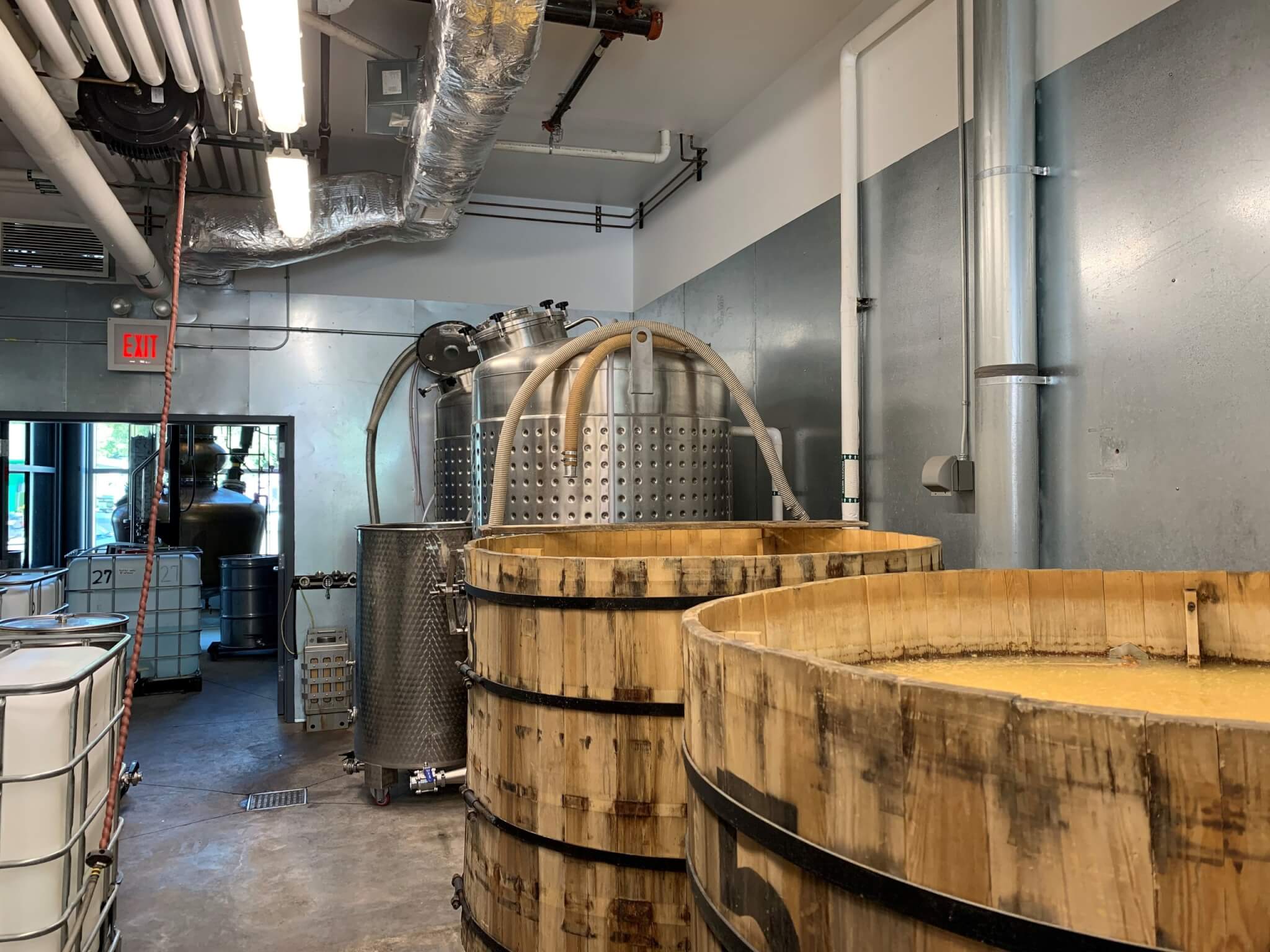
Because SIEMENS automation equipment and software worked well to optimize room temperatures efficiently in their boutique inn, Marble Distilling Co. owners were open to a novel use of the technology to improve the distilling process—and they were rewarded with a 75-percent increase in efficiency as a result. The Carbondale, CO, destination is home to a craft distillery, tasting room, private club, and inn—all designed to make every guest feel as though they are a part of Marble’s mission to become the most sustainable, zero-waste distilling operation in the world.
Owners Connie Baker and Carey Shanks have worked shoulder-to-shoulder with SIEMENS Solution Partner, Holbrook Service, to turn their vision for a sustainable future into the reality of running an emerging distillery. Over several years, they have taken a phased approach to optimizing their operation.
For example, Holbrook and Marble have been perfecting the design and operation of Marble’s water energy thermal system, which captures and reuses both water and heat generated through the distilling process. At the same time, they have focused on maximizing comfort and energy efficiency throughout their inn. They have also deployed enhanced disinfection technologies as well as a whole-systems approach to optimizing and automating their distilling process and controls.
Improving the Distilling Process
Through this partnership, Holbrook’s controls manager, David Carpenter, recommended broad-sweeping solutions to achieve the distillery’s objectives. Carpenter explained that SIEMENS automation equipment and software are critical to optimizing all aspects of the Marble operation. “We have had Desigo DXRs controlling fan coils for guest rooms and Desigo Control Point as the guest interface for their room temperature. And now, we have added the Desigo Automation PXC4 controller to run their distillery equipment,” said Carpenter.
The Desigo PXC family of controllers integrate with a full range of open building automation platforms to deliver increased data processing power and memory. These devices offer flexible control and intuitive engineering with the single, easy-to-use ABT Site commissioning tool.
Typically, the Desigo Automation PXC4 controllers are deployed within the building automation system to unlock efficiencies, improve decision-making, and sharpen building operations. But for Marble, Carpenter took a nontraditional approach and applied the PXC4s to automate the distillery equipment.
“The PXC4 controllers are so easy to program. Even with a unique application that required pulling in multiple valves and actuators and rerunning conduit, the programming in ABT Site essentially took one day,” Carpenter said. “We did a startup and ran the stills right away. All it took was tuning the PID [proportional integral derivative] loops and we were set in a matter of days.”
Automation Saves Time, Energy
Carpenter continued, “It’s all about resource conservation. We’re using the PXC4 controllers for the distilling process, controlling and monitoring water source heat pumps, valves, and actuators.” This setup, in combination with a Desigo Control Point panel installed next to the finish still, provides much tighter control along with performance data.
The distilling process encompasses nine fermenters, a mash tun, and four dozen valves. Baker noted, “To manually control this process with all this equipment would have been impossible. But thanks to the work we’ve done with SIEMENS solutions and Holbrook, it’s fully automated—and I can see everything happening from my phone, too.”
At the end of the day, Carpenter said, real-time data visualization has enabled control over the distilling process to within three-tenths of a degree deadbands. “The graphs are right on the Control Point panel to see history and trends, and Connie can see when to make cuts in real time. With the PXC4, we’ve reduced the number of runs through the still they need to get to the required proof.”
Read the full Marble case study here: https://sid.siemens.com/v/u/A6V13889559
Increased Efficiency
Before the new controls strategy and equipment was installed, Marble needed to run vodka through the still five times to achieve 190 proof, which took approximately 35 hours per batch. Today, the efficiencies made possible by the PXC4 controller mean Marble’s vodka needs to run only one time through the still.
“We’re operating at 25 percent of what we were before, which means that the PXC4 saves us an additional 200 million BTUs per year, or about 20 percent in annual cost savings—on top of what was already a very efficient system,” said Shanks. “It’s a huge improvement in energy savings.”
Adding the PXC4 to its distilling process has enabled Marble to triple its output without adding staff or equipment—and they are setting a new industry standard for sustainable distilling.
 Baker said, “We’re so excited about how the PXC4 controller gives us tremendous power in how carefully we can watch things. It’s truly amazing how one piece of equipment can help us pay so much more attention to runtimes, temperatures, outputs, etc., so we can cut our distillation times and energy use.”
Check out this infographic showing all the ways Marble is saving energy and costs: https://references.siemens.com/api/attachment?uri=Data/Published/33389/Attachments/ex/Infographic.pdf
Sustainable Business Model
Marble appreciates how the Desigo Control Point makes their distilling process data readily visible to customers who come to tour the facility. “When we run tours in the distillery, the Desigo Control Point panel is prominently installed on the wall,” Baker said. “We can flip through the screens and show people how SIEMENS solutions are key to our sustainability and how everyone here is helping us save the planet, one bottle of vodka at a time.”
Holbrook Service has also relied on Desigo Automation solutions in ways that help Marble avoid using fossil fuels for preheating. Baker explained, “We fill our mash tun with 50º F water and then reuse water from our other processes to heat that water up to 110º F without using fossil fuels or dissipating heat. And we don’t need a chiller either—which is rare for a distiller.”
As they continue to discover new ways to further conserve natural resources and optimize their distilling processes, Shanks noted that the team has been taking their lessons learned and best practices on the road. “Other distillers can take what we’ve learned and replicate it within their own existing processes to join us on our journey of saving the planet,” he said.
For more information, visit www.siemens.com.