

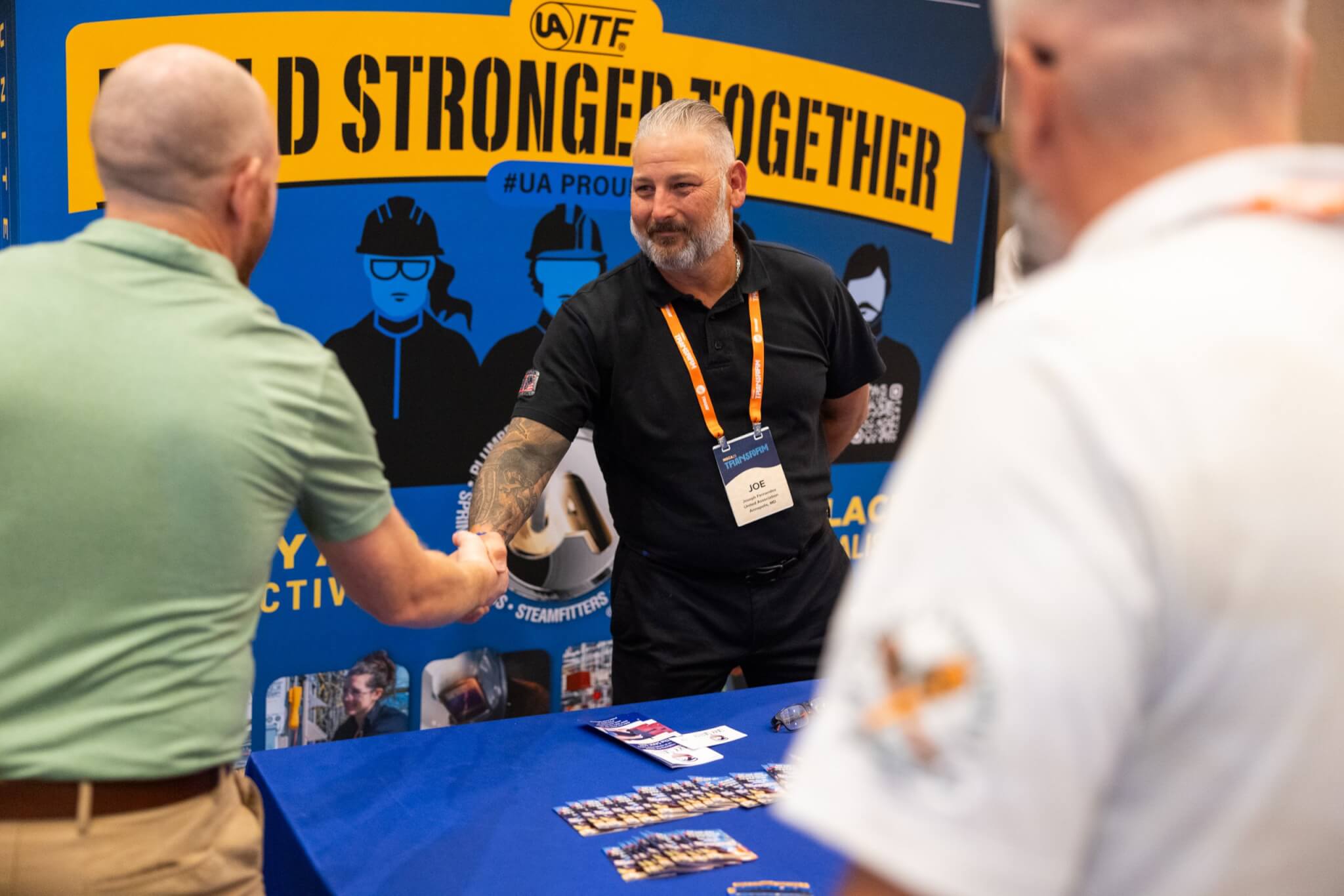
MCAA is proud of its partnership with the United Association. Our partnership not only benefits our memberships; it also benefits our clients — the owners of the projects and facilities we build and maintain. That partnership would not exist without the leadership of UA General President Mark McManus.
Together, MCAA and the UA are preparing our workforce not just for today’s work, but for tomorrow’s opportunities. We’re investing in continuous training, not just for apprentices, but for journey workers, foremen, and service techs at every stage of their careers. Because staying ahead means staying educated and we are united by our commitment to excellence.
National Service And Maintenance Agreement
The current National Service and Maintenance Agreement between the UA and MSCA is in effect from August 1, 2021 – July 31, 2027.
This amended Agreement is entered into this 1st day of August 2021, by and between the Mechanical Contractors Association of America, Inc., and its department, the Mechanical Service Contractors of America, hereinafter called the “MSCA;” and on behalf of contractors who qualify and become signatory to this Agreement, hereinafter called “Employer”, and the United Association of Journeymen and Apprentices of the Plumbing and Pipe Fitting Industry of the United States and Canada, AFL-CIO, hereinafter called the “United Association,” “UA,” or “Union.”
Other National Agreement Summaries
Joint National Industrial Agreement for Instrument Technicians
The history of this UA-IBEW joint agreement goes back to 1983. In 1986, a new agreement was negotiated between the United Association, the International Brotherhood of Electrical Workers (IBEW) and employers. These technicians are now certified in accordance with the strict standards present in all UA certification programs. Training to these standards occurs through a comprehensive curriculum developed by the United Association.
This program was developed because there is and will continue to be a strong demand for highly skilled instrument technicians, with the development and construction of new power plants as well as all the other facilities that call for instrument technicians. These include pharmaceutical plants, semiconductor and other high-tech manufacturing facilities and sophisticated food processing plants, to name only a few. At this time, there are 39 contractors working under this agreement. Although this is an encouraging number, it is the UA’s intention to aggressively pursue more contractors. The United Association has 42 local unions with instrument technician and calibration jurisdiction.
National Industrial Construction Agreement
The National Construction Agreement was originally implemented in 1956 and has been revised many times since then. The agreement was most recently revised effective September 1, 2010, and is now known as the National Industrial Construction Agreement (NC). At the present time there are 68 active contractors signed to this agreement. The agreement continues to serve the United Association and our signatory contractors well and is expected to do so for many years to come.
Mid-South Industrial Agreement
In 2008, the UA chartered the Mid-South Multi-State District Council as part of the effort to expand the UA’s share of the industrial market in the Mid-South region. The Council, which consists of 10 affiliated local unions, has established the Mid-South Industrial Agreement, a comprehensive and flexible collective bargaining agreement that covers industrial work in Alabama and Tennessee. Moreover, the Council has set up a target fund to assist in the effort to grow industrial work opportunities for UA members and is developing other creative programs to capture market share. UA craftsmen have been consistently employed under the Mid-South Agreement, performing construction, maintenance, repair, replacement or renovation work at industrial sites.
National Pipeline Agreement
The United Association National Pipeline Agreement, first negotiated in April 1950 with the National Pipeline Contractors Association, protects the wages and working conditions of over 5,500 United Association members working in the pipeline industry. This agreement, along with large project agreements, has brought stability to the pipeline industry and to the United Association members involved in this area of the trade. Since the incorporation of station work as part of the pipeline agreement, hours worked in this portion of the business have improved dramatically.
Working conditions, wages and fringe benefits of United Association members employed in the pipeline industry have improved as a result of successful negotiations. The Pipeline Industry Benefit Fund continues to provide health, welfare and pensions for the working members.
National Distribution Pipeline Agreement
The National Distribution Pipeline Agreement continues to be an effective and essential agreement throughout the United States. Locals with jurisdiction in the distribution industry have numerous opportunities in this booming area.
As the natural gas industry grows, the United Association is poised to take advantage of the need for skilled manpower in this sector of the pipeline industry. Major system upgrades and completely new systems are planned and under construction in this ever-expanding area. This points to a bright economic future for the natural gas industry and our members performing distribution pipeline work.
The National Distribution Pipeline Agreement and its addendums may be tailored to meet the specific needs of contractors and local unions, making the United Association and union contractors as competitive as possible in the distribution arena.
Establishment of addendums to the agreement has resulted in work in areas of the country that had been traditionally non-union. Broad changes have been implemented relating to freedom of travel in the distribution industry, changes that allow our good union contractors the flexibility to move key personnel from certain areas of the country to establish a workforce into regions unfamiliar with up-to-date industry practices.
Both the National Pipeline Agreement and the National Distribution Pipeline Agreement include substance abuse and alcohol misuse policies that are standards of the industry. These policies acknowledge federal law requiring testing under certain circumstances to promote the highest principles of safety in the pipeline and gas distribution industries, thereby protecting UA members working in this field.
Project Labor Agreements
The United Association, along with other building and construction trade crafts, is continuing to use project labor agreements (PLAs) as an effective tool in winning work for our members in both the private and public sectors. They have provided owners with an economical, efficient way to ensure that their projects are built with a steady supply of skilled productive craft workers.
The vast majority of project labor agreements are between the local building trades council and contractors. These agreements must have the approval of the Building and Construction Trades Department Project Review Committee before they can be implemented. The General Presidents of the Building and Construction Trades Department established the Project Review Committee in 1978 in order to standardize minimum requirements for the agreements. In 2008, the General Presidents further streamlined the process by establishing: an online request form; a copy of the standard PLA meeting all criteria; guidelines for negotiating a PLA and a two-day approval process.
Nuclear Power Construction Labor Agreement
As an extension of the PLA, and in recognition of the national importance of nuclear power, the General Presidents of the Building and Construction Trades Department created the Nuclear Power Construction Labor Agreement. This agreement is intended to address the specific needs of the nuclear industry by designing regional wage rates designed to attract and retain workers on nuclear projects and offering specialized recruitment and training efforts to provide lifelong careers for residents to make nuclear plant construction attractive to local communities.
This agreement is a uniquely full and complete national agreement that does not depend on other collective bargaining agreements in the construction industry, whether local, regional or national in scope. It will serve the efficient, speedy and safe construction of nuclear power plants in the United States.
General Presidents’ Project Maintenance Agreement
The General Presidents’ Project Maintenance Agreement (GPPMA) was revised as of July 2005, and the Interpretations/Bulletins have been revised as of September 2010.
The GPPMA plan is a cost-effective program set forth in a labor agreement designed for all types of maintenance work including repair, renovation, capital improvement and replacement work in all types of industrial plants, energy systems and government installations. The agreement is designed to reduce labor costs by at least 15 to 20 percent and perform work operations in the most efficient and productive manner. In addition, it provides the owner with a quality product at reasonable and competitive costs.
Some of the cost-saving provisions of the GPPMA include:
- Absolutely no strikes, work stoppages, picketing or slowdowns of any type on a GPPMA project.
- Standardization of work hours, overtime provisions and holidays for all crafts.
- Provisions for flexibility in starting times and weekly work schedule.
- Standardization of multiple shift arrangements and work assignment provisions designed to eliminate disputes involving craft work jurisdiction.
- Elimination of ratios of foremen, area foremen and general foremen as established in local or national construction agreements: no mandatory crew size.
- Strict enforcement of drug and alcohol programs.
- Composite crews.
The GPPMA is available to all qualified union contractors who receive a commitment from an owner for contract maintenance work covering an initial period of not less than one year. A separate agreement is issued for each project, except in cases where agreements are granted for multi-plant facilities or systemwide energy projects.
National Maintenance Agreements
Since its inception in 1971, the National Maintenance Agreement (NMA) program has been administered under a system of tripartite governance and cooperation, with owners, contractors and building trades craft workers sharing equally in the responsibilities and rewards generated by the program.
In achieving the goal of “Building a Partnership of Safety, Productivity, Quality and Strength,” the NMA recognizes and addresses the following common concerns of the partners in the program:
- Safety in all phases of work
- No disruptions of owners’ work
- Performance on schedule
- Cost-effective and quality craftsmanship
- Productivity flexibility
- A trained, available workforce
- Attainable work opportunities
- Resolution process for jobsite issues
The NMA program is administered and guided by the NMA Policy Committee, Inc. The NMAPC is a joint committee of labor and management representatives committed to achieving the program’s stated goals and satisfying the individual and collective concerns of the participants.
National Power Generation Maintenance Agreement
Three international unions perform maintenance work under the National Power Generation Maintenance Agreement: the United Association, the International Brotherhood of Boilermakers, and the United Brotherhood of Carpenters. Signatory contractors utilize this agreement to perform maintenance, repair, replacement, and renovation work on power generating stations. This agreement serves owners of power generation plants fueled by nuclear, fossil, gas or synfuels who choose to utilize this agreement tailored to the power generation business.
Please visit the National Maintenance Agreement Policy Committee website, www.nmapc.org for additional information

BECOME A MEMBER
Interested In Joining?
Join the network shaping the future of mechanical contracting and unlock resources, connections, and opportunities to grow your business.