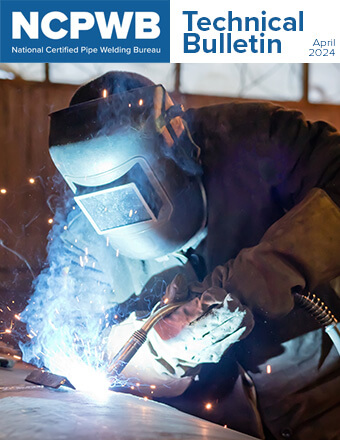
This article presents guidance on what to do when dissimilar metals are used in heating and air conditioning piping systems. NCPWB is grateful to ASHRAE for allowing us to reproduce this article, which was published in ASHRAE Journal, Vol. 51, April 2009.
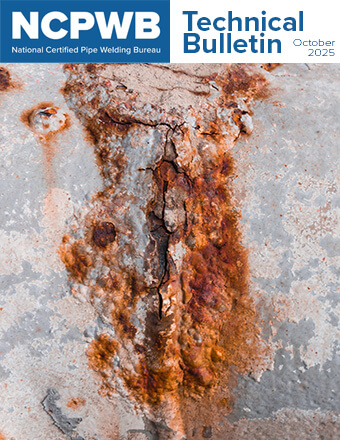
Welding Dissimilar Metals in Heating and AC Piping Systems Technical Resource
Formats for Download
Related Resources
Description:
What is Microbiologically Influenced Corrosion (MIC) and why do contractors need to know anything about it? Well, it turns out that MIC can negatively affect your profits.
Description:
On occasion we get questions from our members who would like to use backing flux in lieu of purging when making welds on stainless steel or other corrosion resistant materials. This bulletin describes an experiment conducted by NCPWB Consultant Walter Sperko where he had a colleague make stainless steel butt welds without any protection of the root of the weld, with inert gas backing, with backing flux and with flux-coated wire.
Description:
When reviewing a Welding Procedure Specification (WPS) or a welder qualification record, the term "backing" frequently appears. In some cases, backing is required, while in others, it is optional. Backing can take various forms, including metal, non-fusing metal, nonmetallic materials, or even weld metal. But what exactly is "backing," and why is it important in welding?
Description:
The E6010 electrode is a wire encased in cellulose held together with salts and minerals. These electrodes penetrate better than low-hydrogen electrodes like E7018 when making root passes, making it easier to make a good root pass. However, E6010 introduces hydrogen into the weld creating a risk of cracking, and this article shows when its use should be limited.
Description:
Piping codes are standard industry practice, and failure to agree on the one that applies to your work can result in ugly disputes with customers. Customer specifications can have inspection requirements that can result in repairs to welds that you did not plan for. Welders can make welds that put your business at risk. This article highlights what you can do to avoid these risks.
Description:
While there is a lot of buzz about modern waveform controlled power sources and how they make it easier for a welder to make the root pass, the basics of MIG welding have not changed. This article describes the technical aspects of GMAW, explains how the metal gets from the wire to the workpiece (transfer modes), and highlights what contractors need to pay attention to when bringing the process into their shop or field fabrication site.
Description:
This bulletin explains how the National Certified Pipe Welding Bureau (NCPWB) Welding Procedure Specifications (WPSs) differ from the American Welding Society (AWS) Standard Welding Procedures in both application and adoption.
Description:
This bulletin explains how to protect welders from exposure to welding fumes and minimize health risks.